
The Jira Data Center integration allows you to connect Casebase to your self-hosted or on-premise Jira instance. This enables you to create Jira Epics from use cases, synchronize field data, and automatically push status updates back into Casebase.
📑 Table of Contents
🔐 1. Prerequisites for the Jira Cloud Integration
⚙️2. Set up the integration between Casebase & Jira Cloud
🗂️ 3. Data Mapping for (Casebase → Jira) & (Jira → Casebase)
🔄 4. Webhook Setup (Jira → Casebase)
📋 5. Displaying linked Jira issues inside a use case
⚡ 6. Troubleshooting
🔐 1. Prerequisites for the Jira Cloud Integration
o successfully connect your Jira Data Center instance to Casebase, ensure the following prerequisites are met:
✔️ Access to an active Jira Data Center instance
Casebase must be able to reach your Jira server from the public internet.
➡️ You are responsible for ensuring that traffic from Casebase is allowed through your network (firewalls, reverse proxies, VPN, allowlists).
Casebase requires outbound HTTPS access to your Jira Base URL, e.g.:
https://jira.examplecompany.com/
✔️ Jira must be able to reach Casebase for webhook delivery
Your Jira server must be able to send outbound HTTPS requests to the Casebase webhook endpoint.
➡️ Ensure that outbound traffic from Jira to external services is allowed, and not blocked by firewalls, proxies, or network restrictions.
If outbound webhook traffic is blocked, Jira → Casebase synchronization will not work.
✔️ A Jira administrator account
Required for:
- creating custom fields
- configuring screens
- setting up webhooks
✔️ A Personal Access Token
Unlike Jira Cloud, Data Center does not use API tokens or admin email authentication. Casebase connects using a Personal Access Token, which you can generate in Jira under:
Administration → Security → Personal Access Tokens
⚙️2. Set up the integration between Casebase & Jira Cloud
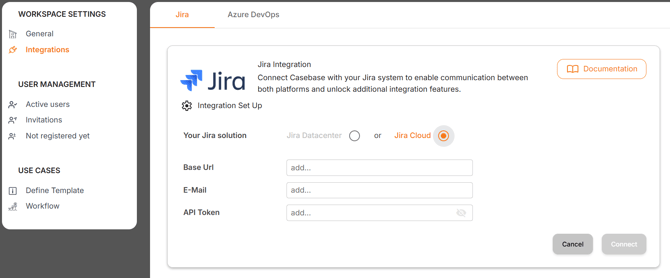
2.1 Initial connection
- Open Workspace Settings → Integrations → Jira in Casebase.
- Click “Connect”.
- Select “Jira Data Center”.
- Enter the required connection details:
- Base URL
- Personal Access Token (More info: 🔗 How to create an Personal Access Token?)
- Click “Connect” → Casebase will automatically validate the connection.
Once successful, all available Jira Integration features will be displayed.
2.2 Enable Features
You can enable each feature independently. A bidirectional synchronization requires both, Casebase → Jira & Jira → Casebase.
Available features:
- Create Jira Epics from Casebase & sync field data | Casebase → Jira
- ⚙️ Configure Data Mapping
- Synchronize Jira data back to Casebase | Jira → Casebase
- ⚙️ Register the Jira Webhook
- ⚙️ Configure Data Mapping
- Display linked Jira issues inside the use case |
- ⚙️Listing different Jira Issue Types
🗂️ 3. Data Mapping for (Casebase → Jira) & (Jira → Casebase)
The Data Mapping defines which fields are synchronized between Casebase and Jira — in both directions:
- Casebase → Jira
- Jira → Casebase
This ensures that all relevant information in a use case and its corresponding Jira Epic remains aligned.
🔍 3.1 Mapping fundamentals
- Casebase only reads and writes fields that are assigned to the Jira Epic issue type.
(Mapping applies globally for Epics, not per project/space.) - Before defining your mapping, consider:
👉 Which Casebase fields should be visible in Jira?
👉 Which Jira fields should sync back to Casebase? - Casebase cannot create new fields in your Jira instance.
(Only Jira apps from the Atlassian Marketplace are allowed to do this.)
➡️ Therefore, we recommend creating the necessary custom fields in Jira before configuring the mapping in Casebase.
🧩 3.2 How to prepare Jira for data mapping
To ensure Casebase can read and update the correct fields, you must create the required custom fields in Jira and assign them to the Epic issue type.
3.2.1 Create a new field in Jira
👉 Atlassian documentation:
https://confluence.atlassian.com/adminjiraserver/adding-custom-fields-1047552713.html
Recommended best practice:
- For Casebase fields that are not long-text fields (dropdowns, selections, fixed-value fields),
use a read-only text field in Jira. - This ensures data integrity and makes it clear to Jira users that this field is controlled by Casebase.
- Add a description such as:
“This field is synchronized by Casebase.”
3.2.2 Assign the custom field to a screen scheme
To make the field available in Epics, assign it to the correct Screen Scheme.
👉 Atlassian documentation:
https://confluence.atlassian.com/adminjiraserver/defining-a-screen-938847288.html
Important: Ensure that the Epic issue type uses this screen scheme in your Jira projects.
3.2.3 Configure the Epic layout
You can adjust the Epic layout for each Jira project (space).
👉 Atlassian documentation:
https://confluence.atlassian.com/jirasoftwareserver/configuring-the-issue-view-938845334.html
📋 Examples for field mappings
| Casebase field | Jira field | Recommendation |
|---|---|---|
| Title | Epic Summary | Standard |
| One-sentence use case | Description | Standard |
| Challenge | Custom Field: Challenge (Paragraph Text) | New custom field |
| Maturity Level | Custom Field: Use Case Maturity (Read-only Text) | New custom field |
| Organization | Custom Field: Organization (Read-only Text) | New custom field |
| Author | Reporter | Jira standard field |
The Casebase Title field is automatically mapped to Epic Summary by default.
⚠️ Important Note on Data Mapping
-
Mapping changes are not applied retroactively.
They only take effect when a use case or the linked Jira Epic is synchronized again. -
Be mindful of mandatory Jira fields.
If you map a mandatory Jira field, the corresponding Casebase field must also be mandatory and contain a value — or the Jira field must already be filled.
Otherwise, the synchronization will fail.
🔄 4. Webhook Setup (Jira → Casebase)
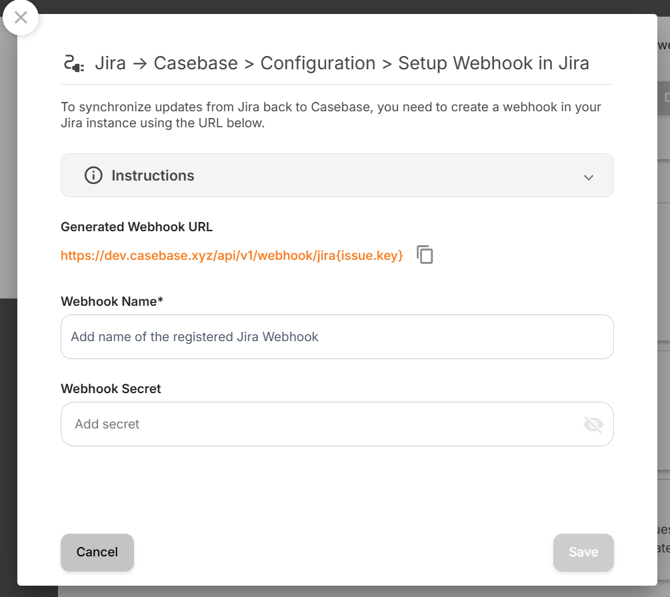
To push updates from Jira back to Casebase, you must configure a webhook in Jira and link it to your workspace. The setup consists of three parts.
A) Start the configuration in Casebase
- Open the Jira Integration Overview in Casebase.
- Go to “Jira → Casebase”.
- Click the ⚙️ settings icon.
- Select “Configure webhook in Jira”.
- Copy the automatically generated Webhook URL.
- 👉 Jira Data Center uses no webhook secret.
B) Create the webhook in Jira
👉 Atlassian documentation:
https://confluence.atlassian.com/adminjiraserver/managing-webhooks-938846912.html
Steps in Jira:
- Open Jira Cloud → System Settings → Webhooks
- Click “Create Webhook”
- Enter a name (e.g., Casebase Integration)
- Paste the Webhook URL from Casebase
- (Optional) Limit webhook events using a JQL filter, e.g.:
project = ExampleProject - Select the event:
issue_updated - Save the webhook.
C) Complete the setup in Casebase
- Return to Casebase → Webhook Configuration
- Enter the webhook name
- Click “Save & complete setup”
After successful verification, the Jira → Casebase feature will be activated.
Note: The same webhook can be used for multiple workspaces
📋 5. Displaying linked Jira issues inside a use case
This feature lets you choose which Jira issues are displayed in a Casebase use case.
Location in Casebase:
Workspace Settings → Integrations → Jira → Issue Listing Feature
You can define:
- Which issue types should be shown (e.g., Story, Task, Sub-task, Bug)
⚡ 6. Troubleshooting
Common issues & solutions:
- Connection failed
→ Check Base URL and Personal Access Token
→ Ensure external network access to Jira is allowed - Webhook not sending data
→ Is the webhook active?
→ Check firewall/proxy logs
→ Verify the correct event is selected (issue_updated) - Mapping not applied
→ Fields must exist and be assigned to the Epic screen
→ Verify custom field permissions & visibility - Jira issues not visible in Casebase
→ Verify issue listing configuration
→ Check project filters and issue types